I want to start with the end.
As the training day drew to a close, I asked the counsellors what they might take away from our time together. One of them said something that gave me goosebumps. She said that somehow, we had all created a space which allowed for vulnerability to be held, so that real conversations could take place about a subject which is highly emotive and painful.
There it was, articulated perfectly. What we’d all felt but perhaps couldn’t quite name. It had been a journey.
I know, I know. That sounds cliché. But I often remind myself that clichés exist because they’re true.
How Did That Even Happen?
When I take a step back, I find myself wondering how we got there. I remember one of my supervisors would often remark on dual process. The concept that what you experience with a client can be played out in supervision itself. (This concept, rooted in psychodynamic theory refers to how patterns and dynamics between client and therapist can mirror themselves in the supervisory relationship.)
Looking back now, I can see the dual process at play in the training room too. We were exploring fertility, a topic full of loss, hope, fear, and vulnerability. Yet the space itself became one where those very qualities could exist safely.
From “No” to “Yes”: Overcoming Imposter Syndrome in Therapist Training
This is completely new territory for me. When I was first explored running a CPD course on fertility counselling, a voice inside my head immediately responded with “You can’t do that”.
It’s one thing to talk about a subject you know intimately. It’s quite another to do it in front of your peers. Peers you respect, peers who you irrationally fear will quietly sit there judging you. This by the way, is reflection of my own insecurities and by no means a reflection of the amazing counsellors who actually came to my training.
But something shifted. Perhaps it was the knowledge that this work matters. Perhaps it was the realisation that if I didn’t do it, who would?
Building the Framework for Fertility Counselling Training
Before sitting down to write the workshop, I felt clear there were three main areas I needed to cover.
First, the landscape of infertility. The journey someone goes through from the moment they realise getting pregnant may not be as straightforward as they’d hoped. This included thew tests carried out, how things are funded, the different treatments people undergo, and the implications potentially involved, right through to the various outcomes.
Once the “factual stuff” was done, we went on a psychological journey together. We explored what is genuinely at threat on a psychological level when you can’t have children, or are at least faced with that prospect. We looked at different counselling models that can help clients make sense of their experience and give them the tools to navigate this journey.
We finished with case studies. The real life, complex, nuanced presentations people may come with. An exercise which I hoped would help participants understand that fertility is often only part of the story, albeit a big current challenge that people bring.
Why Fertility Counselling Matters (And It’s Not As Niche As You Think)
People often tell me how “niche” I am in the part of my practice that focuses on fertility. (It’s worth mentioning I also see many other clients who come to see me for a whole host of reasons.)
Yet it’s not niche at all. The statistics speak for themselves. One in six couples in the UK are currently experiencing fertility issues. In my experience, it’s not uncommon for infertility to be a part of someone’s experience, even if they haven’t explicitly sought out counselling for that particular reason.
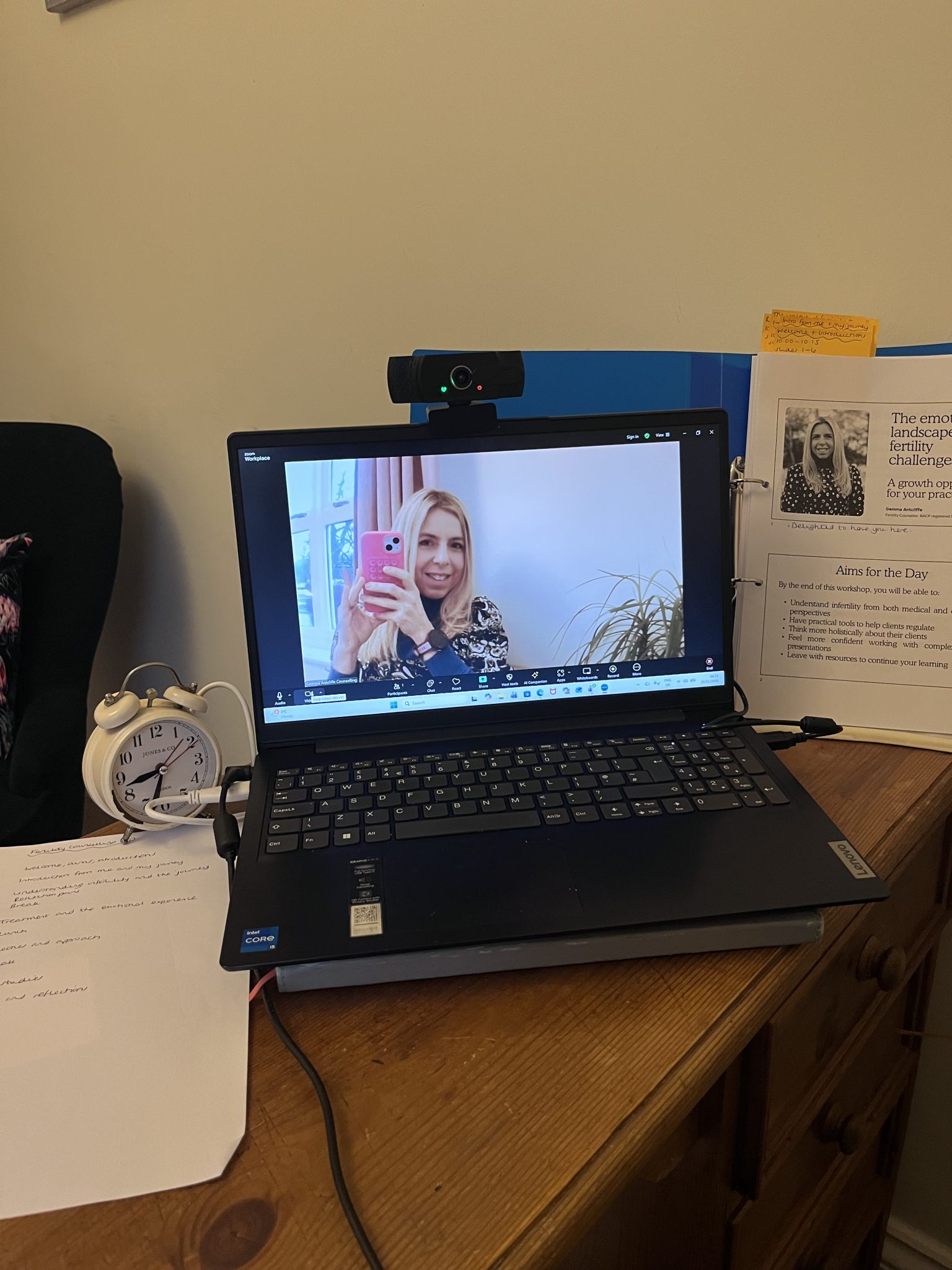
The Day Itself: Therapists Logging in from Across the Country
The training day could not have gone any better. Counsellors joined me online from all over the country, and it was fascinating to hear the reasons they were there.
For some, fertility was coming up in their work. Whether with people in their twenties who weren’t yet ready for children yet feeling fearful about their fertility, or mums who had been touched by infertility and, despite now having a baby, found the experience had left its mark. There were others close to people living through fertility challenges, and some with personal lived experience themselves.
The Power of Being Unapologetically Yourself
I’m going to be honest. I felt exposed going into that training.
In my experience, when I feel that way, the only way I can navigate that feeling is to be unapologetically myself. So I shared my own personal story of infertility, something I do throughout my work. This has to be done with ethics and professionalism, ensuring this sharing comes from the scar and not from the wound. For a long period of time post IVF, it was an experience I actively avoided talking about. But now, it has become an integral part of how I connect with both clients and other professionals.
You know how I said earlier I wasn’t sure where that powerful comment about vulnerability had come from? Well, I think I do know. What I find increasingly in life is this. If you have the courage to be honest, people will be honest back.
The Ripple Effect: Building Confidence in Fertility Support
The outcome of this training exceeded anything I could have hoped for.
People told me it had left them wanting more. For one participant, it inspired her to plan her own journey into specialising in this area. And they all agreed on one thing. They felt more confident to work with clients experiencing fertility challenges.
Their words stayed with me:
“Before the workshop I felt not clued up enough to ask the right questions or feared saying the wrong thing, but now I feel more than competent.”
“Before the workshop I felt uncertain and out of my depth, but now I feel better informed.”
Why I Do What I Do: Supporting Therapists to Support Others
When I reflect on my “why”, a question most mentors will ask you at some point, I realise this training is now a part of my business that isn’t going away.
This is because I can say, without a shadow of a doubt, that experiencing infertility was one of the most isolating experiences I have ever been through. Part of that isolation was feeling like no one “got it”. Even if they wanted to and tried.
If I can help other counsellors get it, so their clients feel seen and held by someone who isn’t sat there frozen because they don’t want to ask the wrong question, then that makes me feel warm inside.
Because every person navigating infertility deserves to feel understood. They deserve a counsellor who can sit with them in their pain, their fear, their anger, their grief, and not look away.
And if I can help create more of those counsellors? Well, that’s worth every moment of vulnerability it took to press that “start meeting” button and share my story through a screen.
About the Author
Gemma Antcliffe is a fertility counsellor specialising in fertility counselling and support. With 15 years of experience and personal lived experience of IVF, she provides specialist counselling to women navigating the emotional journey of fertility treatment. Gemma is registered with BACP and BICA.
Interested in Fertility Counselling Training?
If you’re a counsellor interested in future fertility CPD training, or if you’re experiencing infertility and looking for specialist support, please reach out. You can find more information at gemmaantcliffe-counselling.co.uk